The Loadable Training Block
A four-week squat, bench press and deadlift block in which every working weight is one your own bar and plates can make: an honest max from the lower of two estimates, every load rounded down to a total your pairs make, and weight or reps added by the jump your plates allow
GymRec's Plate Loading Calculator assumes a full rack: every plate size, as many as you like. A home, garage or hotel gym has a few pairs, and a percentage program asks for weights like 127.27 kg that no bar can hold. Nothing on the site says which totals your own plates make, which weight to round to, or whether your jumps are small enough to add every week. The Loadable Training Block works that out. You weigh the bar and collars, count plates in pairs, list every total they make, and test which single extra pair would change your plan. Your max comes from a recent set through both the Epley and Brzycki formulas, and you plan from the lower one; each working weight is the exact weight for one more rep than you will do, rounded DOWN to a total on your list. In the worked example a 20 kg bar with two pairs of 20s and one pair each of 10s, 5s and 2.5s makes 24 totals in 5 kg jumps: on a 90 kg squat that is a 5.6% jump, so the squat adds reps at 85 kg. One pair of 1.25 kg plates halves the jump, and the squat runs 87.5, 90 and 92.5 kg with a rep still in reserve. Every figure is computed by code from GymRec's own calculators and every worked number is an example. It is not medical advice: check with your doctor first if you have a health condition, use safeties or a spotter for heavy squats and bench presses, and stop a set for sharp pain. It says nothing about food, body weight or supplements. Included: seven steps, a plate inventory sheet, a loading card, a block card, a session log, reference tables, a quickstart, and a personalised sheet worked from the numbers you enter in the One-Rep Max and Plate Loading calculators.
Look inside
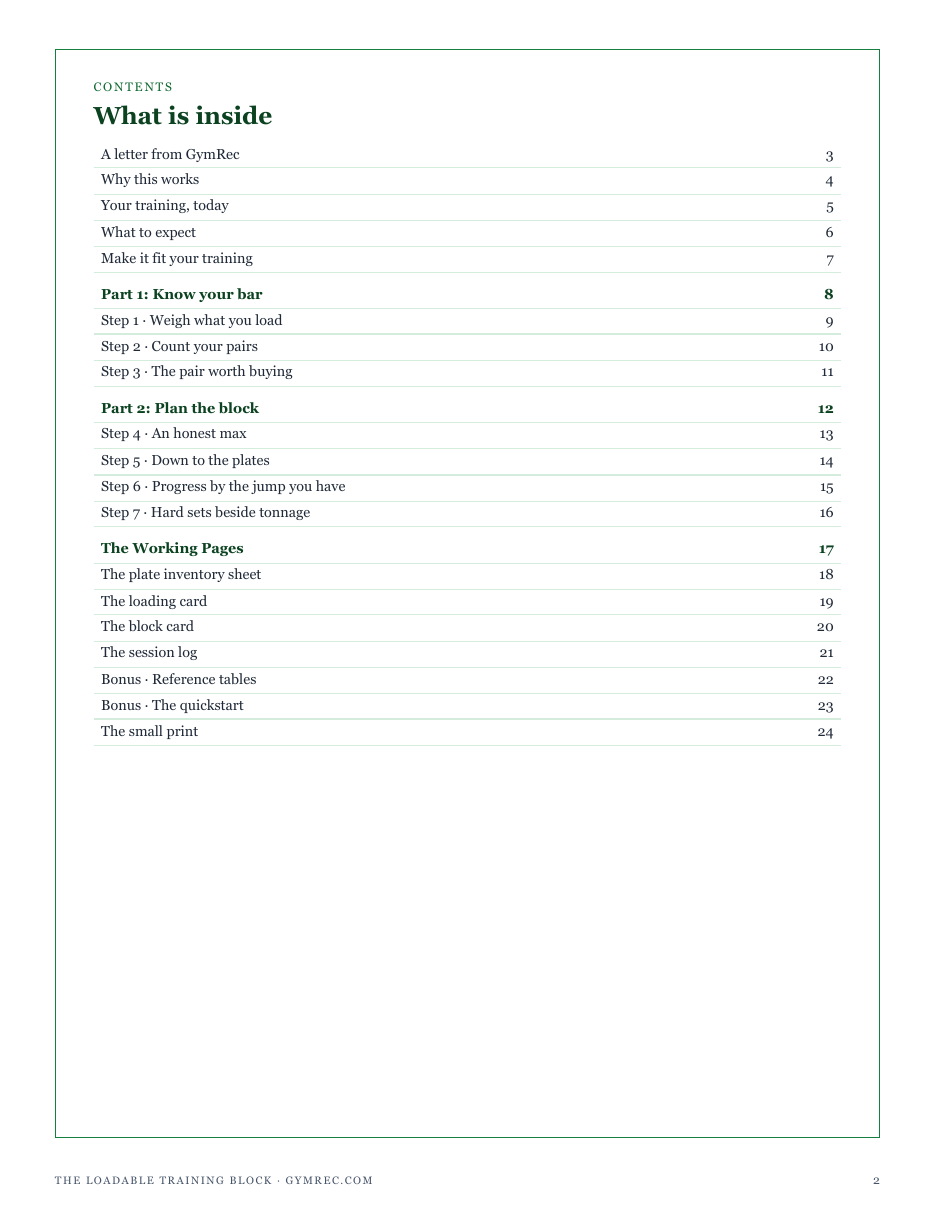
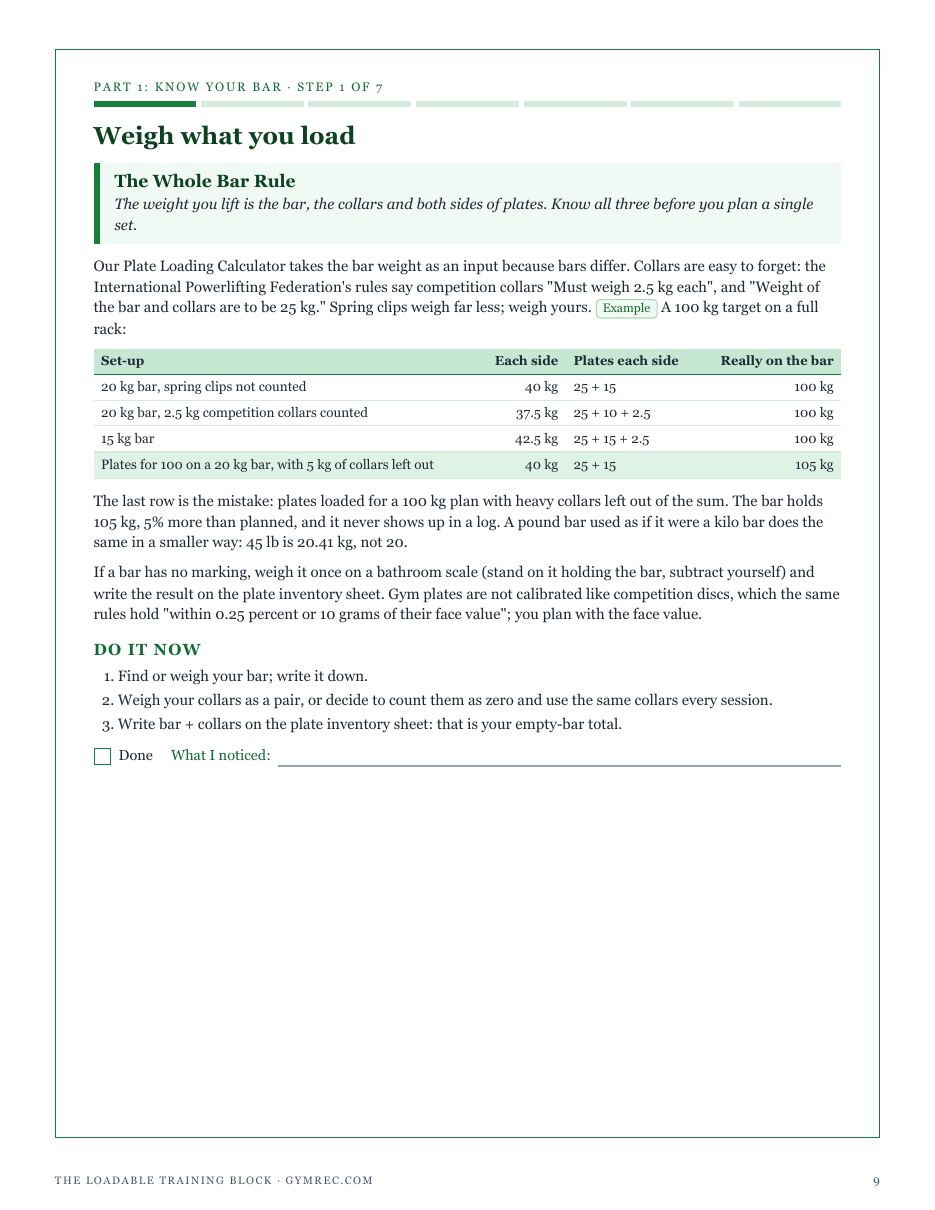
Two full pages from the block, exactly as printed. Click either to read it at full size before you decide.
What is in it
- Step 1: the whole weight you load: bar, collars and both sides, with the IPF's collar rule quoted
- Step 2: your plates counted in pairs, every total they make, and the biggest jump between them
- Step 3: the one extra pair worth buying, tested against your plan before you buy a set
- Step 4: an honest max from a recent set through Epley and Brzycki, planning from the lower
- Step 5: every working weight rounded down to a total your plates make, never up, including a kilo plan in a pound gym
- Step 6: add a plate jump or a rep each week, decided lift by lift by the size of the jump, with a deload week
- Step 7: hard sets logged beside tonnage, and why the light high-rep session is not the harder week
- Working pages: a plate inventory sheet, a loading card with warm-ups, a block card and a session log
- Reference tables: Epley against Brzycki for 1 to 12 reps, plate jumps as a percent of the working weight, kilos and pounds
- A personalised sheet worked from the numbers you enter in the One-Rep Max and Plate Loading calculators
- ✓ 24 printable pages
- ✓ 10 sections, worksheets and templates
- ✓ A second PDF worked out from the numbers you enter
- ✓ No account needed, just an email address
- ✓ Instant download; link valid 7 days
Price includes any taxes. Sold by GrabURL, who handle checkout and support. The charge appears on your statement as GrabURL.
The block picks up where the free Plate Loading Calculator and Training Volume Calculator leave off. One loads any weight from a full rack of plates, the other adds up sets x reps x load; the block joins them to the plates you actually own: the bar and collars weighed, every total your pairs can make, the one pair worth buying, an estimated max from the lower of the Epley and Brzycki formulas, every working weight rounded down to a load your plates make, weight or reps added by the jump your plates allow, and hard sets logged beside tonnage. It is not medical advice; check with your doctor first if you have a health condition, and use safeties or a spotter for heavy squats and bench presses. Every figure in it is an example for you to replace.